
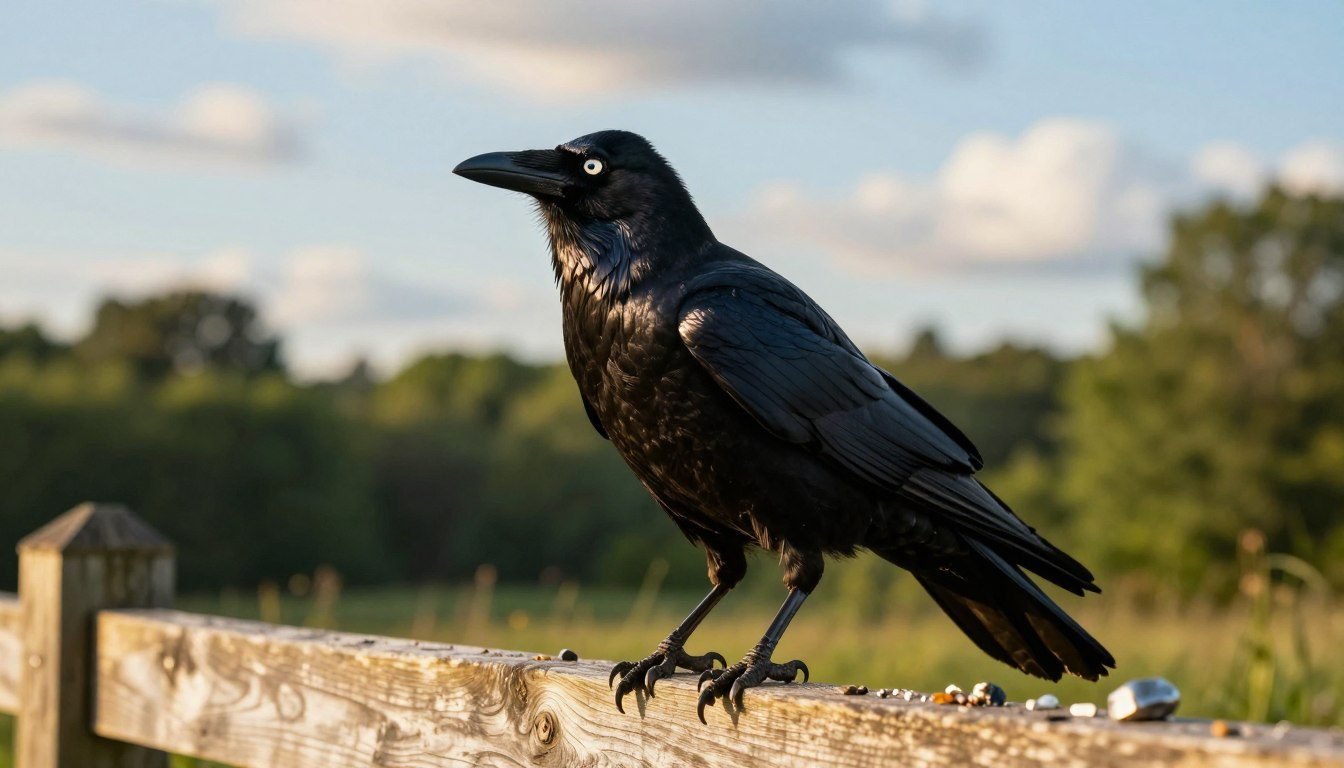
Did you know a crow can remember a human’s face for over five years? This isn’t a fairy tale. It’s a surprising fact from research. It makes you wonder what else is happening in those clever, feathered heads.
We often think of smart creatures as dolphins or apes. But look to the skies. The common crow has a mind that rivals a young child’s problem-solving skills. Their abilities make us rethink what we know about brains and brilliance.
This article offers incredible insights into a world of advanced cognition. We’ll explore the mysterious behaviors you never knew existed. From crafting hooks to fish for Food to holding funerals for their dead, their actions reveal a depth of thought that is truly astonishing.
Key Takeaways
- Crows demonstrate cognitive abilities that can rival those of a 5 to 7-year-old human child.
- They are master tool engineers, creating and modifying objects to solve complex problems.
- These birds have intricate social structures and can remember individual humans for years.
- Their problem-solving often involves future planning and innovative thinking.
- Crow intelligence challenges long-held ideas about what makes human minds unique.
- Ongoing research continues to uncover unexpected mental capacities in the animal kingdom.
Animal Intelligence: Meet the Crow, Nature’s Feathered Genius
Primates are not the only smart ones in the animal world. Crows, ravens, and their relatives are true geniuses. They can make tools, solve problems, and remember things like no other species.
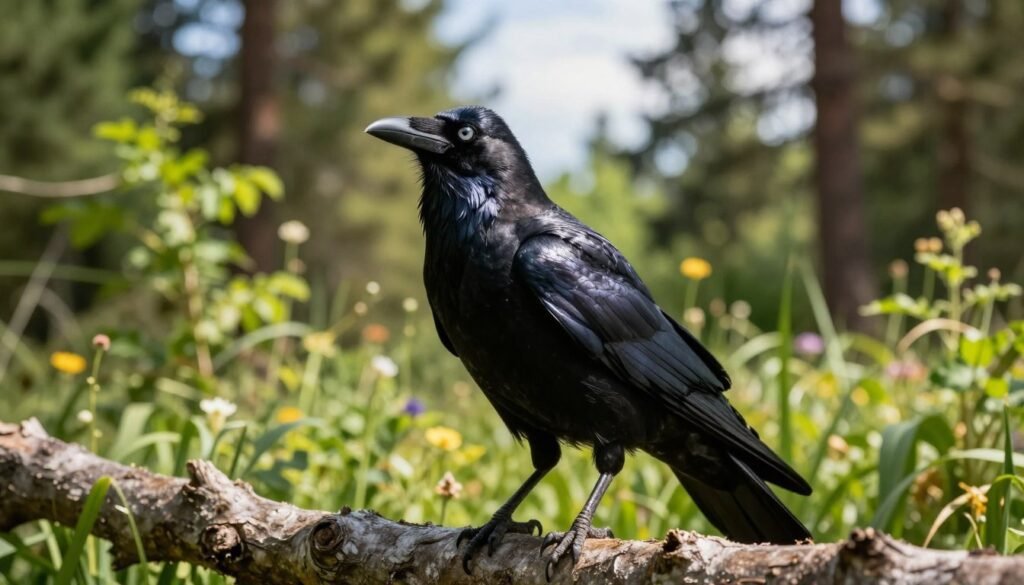
Beyond the “Birdbrain” Myth
For years, people thought birds were dumb. But this idea was wrong. Scientists now know that bird brains are actually very complex.
Studies show that bird brains, like those of crows and parrots, have lots of neurons. These neurons are in a part of the brain called the pallium. It’s like the mammalian cerebral cortex, where smart thinking happens. Their brains are wired to solve problems.
This brainpower lets crows do things once thought only humans and great apes could do. They think, plan, and even innovate.
The New Caledonian Crow: A Case Study in Cognitive Prowess
The New Caledonian crow is the smartest of all crows. It lives on Pacific islands and is a favorite of scientists.
These crows are super smart because of their environment. They need to get Food from hard-to-reach places. So, they make tools from twigs and leaves.
“The New Caledonian crow doesn’t just use tools; it manufactures them with a precision and foresight that suggests a mental blueprint.”
Scientists study these crows to learn about physical cognition. They can solve puzzles and plan actions. This shows they are as smart as a 5- to 7-year-old human.
By studying the New Caledonian crow, we learn about intelligence in the animal kingdom. It shows us how smart birds can be.
Engineering with a Beak: Crows as Master Tool Users
Imagine a bird looking at a straight piece of wire and thinking, “I need a hook.” For a crow, this is not just imagination. They are experts at using tools, designing, making, and changing them to solve problems. This makes them part of a special group of tool-using animals, showing one of the great natural wonders.
The Wire-Bending Experiment That Shocked Scientists
A famous study at the University of Oxford showed how clever crows are. A crow named Betty was given a vertical tube with a small bucket of Food. She had a straight wire and a hooked wire to choose from.
When the hooked wire was taken away, Betty had to think. She picked up the straight wire and bent it into a hook. Then, she used her new tool to get the Food. This amazing act of creation shocked scientists everywhere.
Insight and Innovation in Action
Betty’s action showed she had insight into learning. She didn’t try random things. She saw the problem, thought of a solution, and made it work on her first try. This shows she planned and thought things through.
This ability to generate new ideas shows that crows are very smart. They can understand what objects can do. They see tools where others might see trash.
Sculpting Tools in the Wild: The Pandanus Leaf Industry
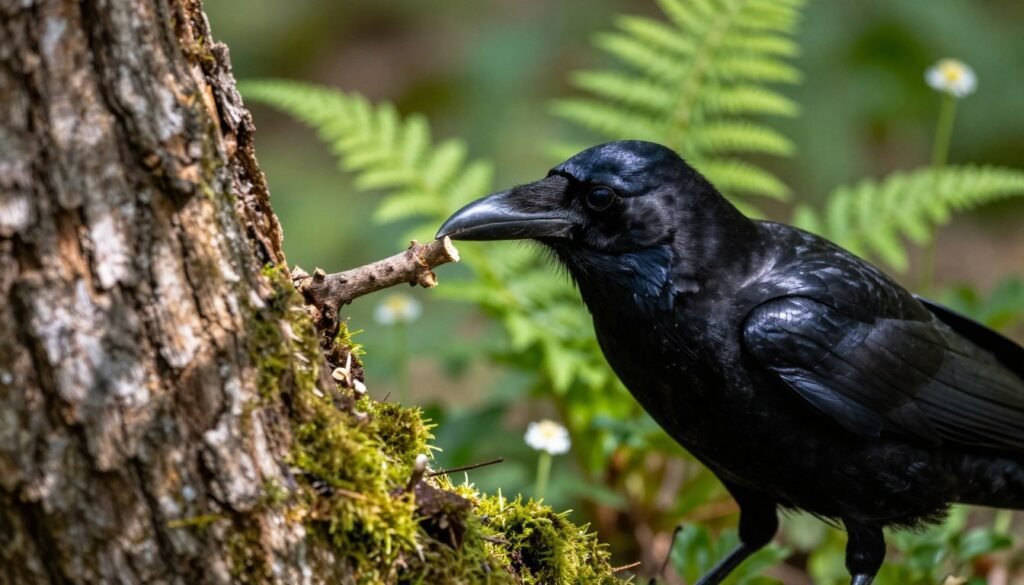
While Betty’s wire-bending was amazing, wild crows have their own toolmaking traditions. New Caledonian crows are famous for their tools. They don’t just find sticks. They make special tools from pandanus leaves.
The process is very detailed. A crow uses its beak to cut a leaf into a tool. They make tools with a broad base and a narrow, hooked tip. This design helps them get insects from tight spots. Different groups of crows even have their own tool styles.
This isn’t just instinct. It’s a skill passed down from adults to young ones. Young crows spend months watching and practicing. Their tool designs are like human crafts, showing a deep understanding of their environment. This is an incredible natural phenomenon.
The lab experiment and the wild behavior show that crows are more than just tool users. They are engineers. Their beaks are tools for making things. This shows their intelligence and is a wonder of the natural world.
A Memory That Never Quits: Caching, Faces, and Grudges
Crows are known for their amazing memory. They can recall details for a long time. This is not just simple remembering. It’s a complex system that helps them survive in different wildlife environments.
Episodic Memory: The Food Cache GPS
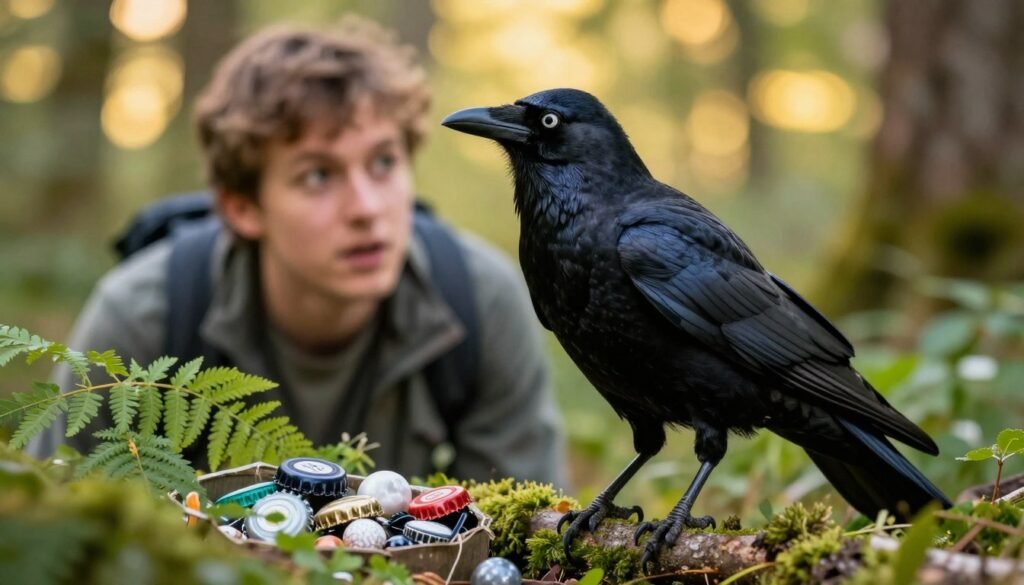
Imagine hiding snacks all over a city and remembering where they are months later. Crows do this all the time. This skill is called episodic memory.
It lets them remember the what, where, and when of past events. Scientists used to think only humans had this ability.
Studies on the Clark’s nutcracker show they can recall over 30,000 seed caches. Crows have the same skill. They remember where Food is buried and which items spoil first. This helps them get the best Food before it goes bad.
“The precision of a crow’s spatial and temporal memory is a cornerstone of its survival strategy in harsh climates.”
This mental map helps them survive in tough environments. It’s a big advantage in the competitive world of wildlife.
Facial Recognition and the Art of the Grudge
Crows take offense seriously. Scientists wore masks while catching and banding crows. Years later, crows would scold anyone wearing the “dangerous” mask.
They ignored neutral masks. This shows crows can remember human faces for years.
This skill isn’t just for remembering enemies. Crows also remember people who feed them. They bring gifts to these kind people. This ability is rare in animals.
It changes how crows interact with others. Every encounter is remembered for future use.
How Crows Pass on Warnings
Crows don’t keep warnings to themselves. They have a system for sharing danger information. When a crow spots a threat, it doesn’t stay quiet.
It starts a behavior called mobbing. The crow calls loudly and dives at the threat. This does three important things:
- Alerts nearby crows to danger.
- Teaches younger crows to recognize threats.
- Strengthens community bonds through defense.
Researchers found that these warnings can spread through crow populations. A single bad encounter can make a whole area dislike a face. This shows advanced wildlife intelligence.
It makes a social network where safety info is valuable.
The Social Network: Complex Crow Societies and Communication
Crows don’t just flock together. They live in complex social networks with rules and a rich language. This advanced animal behavior shows their intelligence. It helps them solve problems and share knowledge.
Their communities are like neighborhoods, not just random groups. This makes them stand out.
Family Ties and Cooperative Living
Many crow species, like the American Crow, live in cooperative breeding systems. Young crows often stay with their parents for years. They become helpers at the nest.
They help defend the territory, gather Food, and feed new chicks. This creates a safe learning environment for the young. It also increases their chances of survival.
This cooperative animal behavior forms extended family groups. These groups can join together in larger communities. The bonds they form are strong and last long.
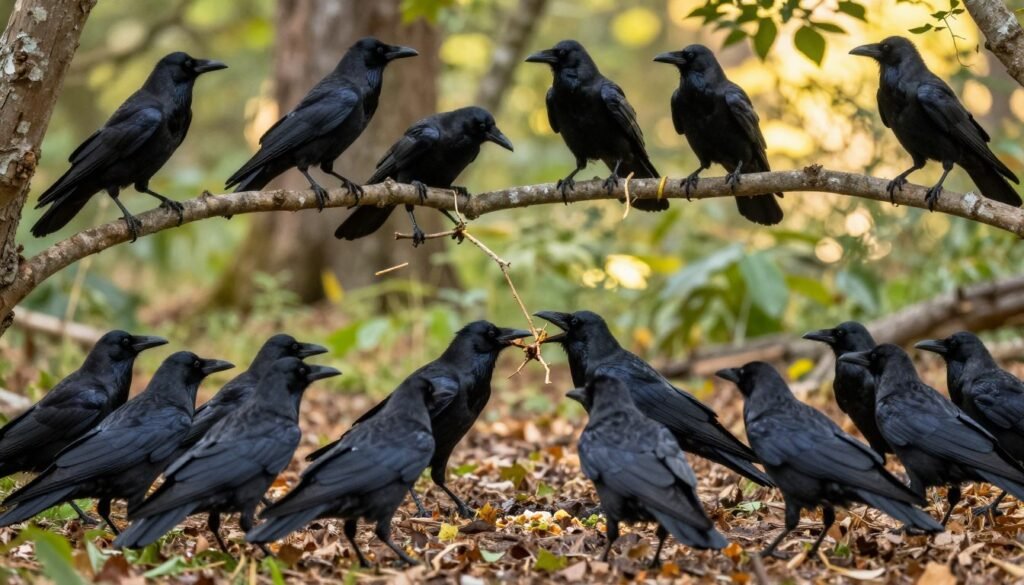
Deciphering the Crow’s Vocabulary
Crows have a wide range of vocalizations, not just a simple “caw.” Researchers have found different calls for various situations. This creates a complex communication system.
- Alarm Calls: The classic harsh “caw” alerts others, but crows have specific calls for different predators. A call for a perched hawk is different from one for a ground-based cat.
- Assembly Calls: These calls gather family members or group allies, often in a more melodic or rattling tone.
- Social Chatter: Softer, gurgling, and cooing sounds strengthen social bonds within the family unit.
- Mobbing Calls: A specific, intense, and repetitive call is used to coordinate group harassment of a threat.
This detailed vocabulary allows crows to share detailed information. It turns them into a coordinated social unit. Their advanced communication is a key part of their social animal behavior.
Studies show crows can pass on information about “dangerous” humans to their offspring. This shows how communication shapes their collective knowledge and survival strategies.
Their social structure and communication skills work together. Their tight-knit families and rich language build a society where intelligence is shared. This makes them highly intelligent.
Outsmarting the Apes: Problem-Solving Prowess
Imagine an animal that can solve a multi-step puzzle. Picture a crow doing just that. Their cognitive abilities go beyond using tools. They show logical reasoning and strategic thinking.
In controlled experiments, these birds solve problems that stump many mammals. This includes our primate cousins.
The Crow and the Water Jug: Aesop’s Fable Comes to Life
Scientists turned a classic fable into a real-world test. They gave the crows a tube of water with a tasty treat floating on the surface. The treat was just out of reach.
The solution required dropping heavy objects into the tube to raise the water level. The crows didn’t just try anything. They assessed the situation.
They chose stones over lighter, floating objects. They understood that the water level would rise only with the right materials. This showed a grasp of basic cause-and-effect physics.
One researcher noted,
This isn’t simple trial and error. The crows appear to have a functional understanding of water displacement.
This experiment proved that crows can innovate solutions to novel challenges. This is a hallmark of advanced intelligence.
Sequential Puzzles and Planning Ahead
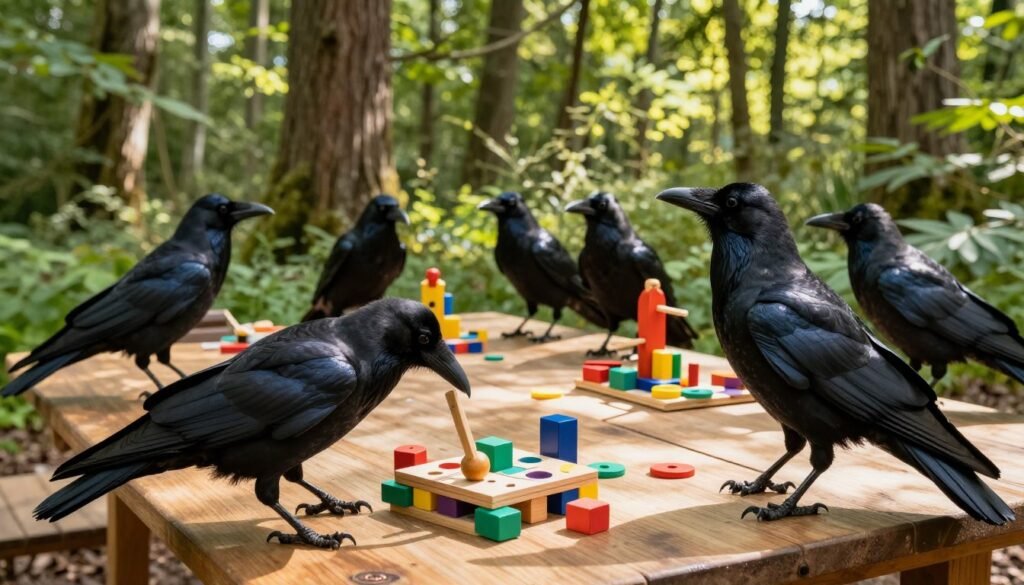
Even more impressive are tasks that require a chain of actions. In one famous setup, a crow needed to use a short stick to pull a medium stick from a cage. Then, it used that medium stick to retrieve a long stick.
After that, the long stick was the only tool that could reach the Food. The crow had to execute these steps in the correct order. Failure at any point meant starting over.
Remarkably, the birds often succeeded on their first attempt. This indicates an ability to plan several moves, much like a chess player thinking through sequences.
This capacity for sequential problem-solving suggests abstract reasoning. The crow isn’t just reacting to the immediate environment. It is holding a multi-step goal in its mind and working backward to achieve it.
These amazing creatures demonstrate cognitive flexibility that rivals that of much larger-brained animals. Their prowess in these complex puzzles solidifies their status as one of nature’s most intelligent and truly amazing creatures.
Why Are Crows So Smart? The Science Behind the Intelligence
What makes a bird smarter than a primate? It’s a mix of brain biology, survival needs, and social life. Crows’ amazing skills come from specific scientific facts.
This intelligence helps crows survive in many places. It shows their important role in biodiversity.
Brain Structure: Neuron Density and the Avian Pallium
For years, we thought big brains meant smart. But birds, like crows, have different brains. They don’t have the folded cortex we do.
Crows have a brain area called the avian pallium. It does complex tasks like ours. The key is how their brains are packed.
Their brains are full of neurons, like a supercomputer in a small body. This lets them use tools, remember, and solve problems.
It’s a classic case of not judging a book by its cover. Their brain’s design, not just size, makes them smart.
The Evolutionary Pressures of a Dynamic Diet
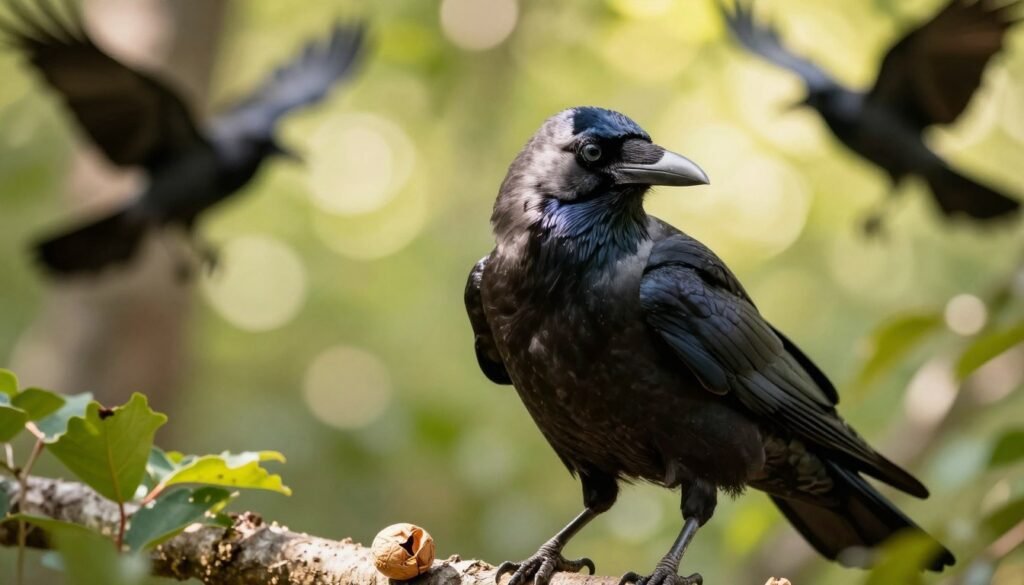
Survival teaches crows a lot. They eat everything from insects to roadkill. This varied diet makes them creative.
They learn to:
- Cache Food and remember thousands of spots.
- Extract prey from hard shells or tricky places.
- Know what’s safe to eat and what’s not.
Each new Food challenge makes them smarter. Over time, this shapes their inventive minds. Their foraging also helps biodiversity by spreading seeds and controlling pests.
Social Complexity as a Cognitive Gym
Living in a crowded society is tough, but great for the brain. It’s like a never-ending brain workout.
Crow groups are complex, with family bonds, alliances, and rivals. Each crow must keep track of who’s who.
They remember faces, human and bird. They hold grudges and share this info with their young. They also form cooperative friendships.
Navigating this social maze requires:
- Advanced communication skills.
- The ability to understand another’s perspective.
- Long-term memory for social history.
Your reputation matters in a crow community. This social world is a constant challenge, making them smarter to survive.
Brain density, a tough diet, and complex social life explain crows’ legendary intelligence. These are the scientific facts behind their smart minds.
Conclusion
Crows are true master toolmakers, social strategists, and problem-solvers. They are not just clever. Their minds are as sharp as some primates’.
Their abilities challenge the old “birdbrain” myth. Crows make us rethink what we mean by intelligence. This change helps us better understand animal minds.
Learning about crow intelligence is very important. It teaches us to respect the minds around us. Every park and forest is full of complex thinkers.
Watching crows can be truly amazing. Look at how they use tools or interact with each other. It makes us appreciate nature more.
This new knowledge changes how we see the world. The next crow you see is an engineer with a great memory. It shows the power of evolution.
We live with incredible beings in our environment. Recognizing their intelligence helps us live better together. The story of crows encourages us to explore and learn more.
