
 Mono Roso
Every year, a silent army of over 40 billion birds takes to the skies. Their epic travels connect continents and defy our understanding of distance.
These animals fly thousands of miles, often returning to the same backyard or wetland. How do they find their way across vast oceans and unfamiliar landscapes without a map?
The answers lie in a mix of incredible instincts and environmental cues. Unlocking the secrets of migratory bird behavior is more than just fascinating science. It is crucial for protecting species that are vital to ecosystems around the world.
This article reveals the hidden mechanisms behind these phenomenal journeys. We will explore the innate guidance systems and remarkable adaptations that enable such cross-continental navigation.
Key Takeaways
- Billions of birds undertake incredibly long, annual journeys that span the globe.
- Their ability to navigate precisely across vast distances relies on a combination of innate tools.
- Scientists believe birds use the sun, stars, Earth’s magnetic field, and even smell to find their way.
- Understanding these travel secrets is key to conservation efforts and protecting flyways.
- Migration is a fragile phenomenon, threatened by habitat loss and climate change.
- Each species follows a unique and often perilous route driven by instinct and learned behavior.
The Marvel of the Annual Journey
Imagine a journey spanning thousands of miles, undertaken twice a year with pinpoint accuracy, by creatures weighing mere ounces. This is the reality for billions of birds across the globe. Their annual migration is not a casual trip but a fundamental, life-or-death ritual written into their very DNA.
The primary drivers are clear and powerful. Birds migrate to find the best resources for raising their young. They travel to abundant summer breeding grounds where Food is plentiful, and daylight is long. When winter approaches, they flee to warmer climates where they can find Food to survive. This relentless pursuit of ideal conditions is the engine of the entire phenomenon.
The scale of this movement is staggering. Consider the Arctic Tern, a bird that makes a round-trip journey from the Arctic to the Antarctic and back each year. That’s over 40,000 miles. Overall, the diverse bird migration patterns we see represent one of Earth’s largest mass movements of animal life. It’s a global reshuffling that touches every continent.
Such epic voyages demand incredible physical sacrifice. Birds undergo dramatic physiological changes. They build massive fat reserves to fuel their flight. Their muscles and organs adapt for extreme endurance. They face daunting natural barriers like vast oceans, towering mountain ranges, and harsh weather, often flying for days without rest.
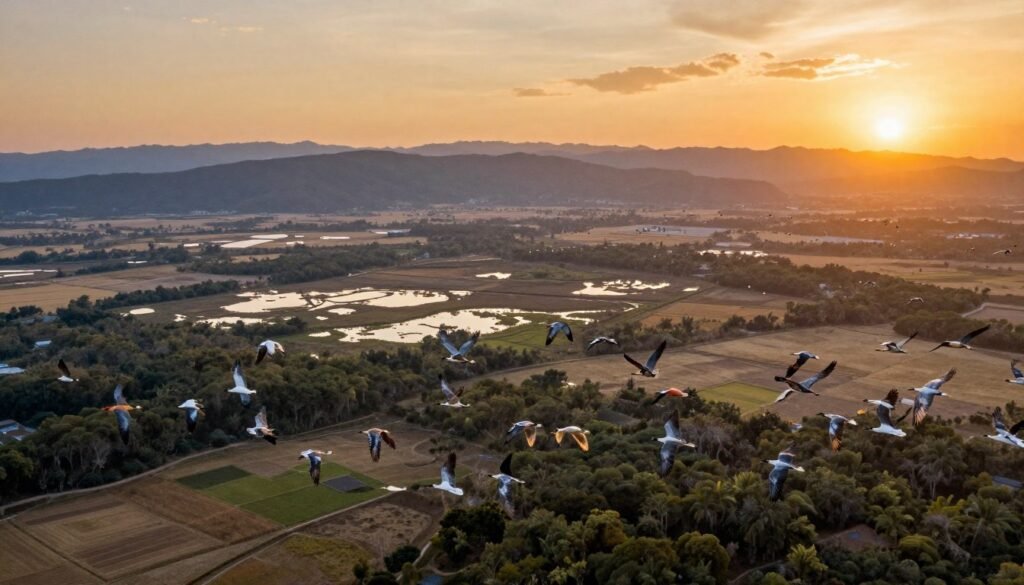
Not all birds follow the same script. Scientists categorize these journeys into several broad types of movements. The most familiar is latitudinal migration, the classic north-south journey between breeding and wintering grounds. Then there’s altitudinal migration, where birds move up and down mountain slopes with the seasons.
Other patterns are less predictable. Irruptive migration occurs in irregular bursts, often when Food sources like cone seeds fail in a bird’s usual range. Some species are even nomadic, wandering vast areas in search of resources without a fixed schedule. Understanding these categories helps us map the complex tapestry of avian movement.
This annual journey is a testament to resilience and instinct. It is a silent, awe-inspiring force that connects ecosystems across the planet. The very existence of these intricate bird migration patterns poses a profound question: how do they find their way?
Migratory Bird Secrets: Navigating Across Continents
Unlocking the mysteries of avian navigation reveals a complex interplay of innate senses and learned behaviors. Birds do not simply fly north or south. They follow precise, often inherited, pathways using a blend of celestial cues, magnetic senses, and memory. This internal guidance system is what allows a tiny warbler to find its way from Canada to the Amazon year after year.

1. Celestial Maps: Steering by the Sun and Stars
Long before humans had GPS, birds were using the sky as their map. Many species possess a sun compass. They track the sun’s position throughout the day to determine direction. This ability requires an internal clock to compensate for the sun’s movement.
At night, migrants turn to the stars. Experiments with indigo buntings in planetariums showed they navigate by the northern constellations, especially the area around Polaris, the North Star. Young birds seem to learn this star map during their first migration.
This celestial system is not foolproof. The growing environmental impact on migratory birds includes light pollution. Bright city lights can drown out starlight, confusing birds and causing fatal collisions. Scientists track migratory birds using light-level geolocators to study how artificial light disrupts their celestial navigation.
2. Sensing the Earth’s Magnetic Field
Perhaps the most astonishing secret is a bird’s ability to feel the Earth’s magnetic field. This sense, called magnetoreception, acts as a built-in global positioning system. It provides both directional information (a compass) and positional data (a map).
The Compass in Their Eyes
Research suggests the primary compass may reside in a bird’s eyes. Special light-sensitive proteins, called cryptochromes, are thought to react to the Earth’s magnetic field. This reaction may create visual patterns or shades that only the bird can see, literally painting direction across its field of vision.
This “compass” requires light to work, linking it directly to the celestial navigation system. It’s a brilliant example of sensory integration.
The Map in Their Beak?
For decades, scientists believed iron-rich cells in a bird’s upper beak provided the magnetic “map.” These cells were thought to sense the intensity and inclination of the magnetic field, telling the bird its location. Newer studies have challenged this idea.
The current theory is more complex. The map might involve multiple sensory inputs, possibly including the eye-based compass and olfactory cues. The exact mechanism remains one of nature’s great puzzles, actively studied through advanced techniques for tracking migratory birds.
Human-made electromagnetic noise, from power lines to radio waves, can have a significant environmental impact on migratory birds, potentially scrambling their delicate magnetic sense.
3. Mental Landmarks and Learned Routes
Not all navigation is hardwired. Many birds use familiar landscapes. They memorize coastlines, river valleys, and mountain ranges. A sandhill crane follows the Platte River in Nebraska. A goose recognizes the shape of a specific bay.
This knowledge is often passed down. Young birds traveling with experienced adults learn the route. If they get separated, they can fall back on their innate compass senses. Some key landmarks birds use include:
- Major river systems (Mississippi, Amazon)
- Mountain ranges (Andes, Rockies)
- Desert edges and coastal shorelines
- Distinct forest types or wetlands
This reliance on memory makes them vulnerable to habitat loss. Changing a familiar stopover site through development directly affects migratory birds, depriving them of crucial rest and Food. Conservationists use tracking data on migratory birds to identify and protect these vital corridors.
In the end, a bird’s journey is guided by a layered strategy. It uses the stars for a general heading, fine-tunes with its magnetic map, and corrects course using the landscape below. It is a seamless fusion of instinct, learning, and ancient sensory perception.
Charting the Skyways: Major Routes and Incredible Patterns
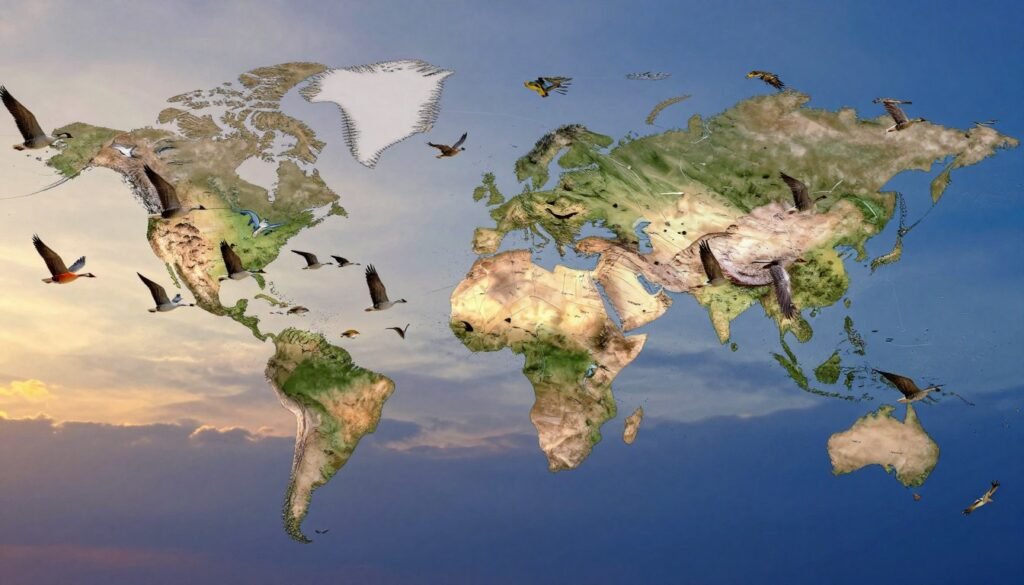
Across the globe, invisible highways in the sky guide millions of birds on their seasonal travels. These bird migration routes are not random but form a predictable, ancient network. Understanding where birds go reveals the scale and coordination of this natural phenomenon.
1. The World’s Great Flyways
Scientists recognize several major continental corridors, or flyways, that funnel travelers between breeding and wintering grounds. Each supports a unique community of species.
- The Atlantic Flyway: This route follows the eastern coastline of North America. Birds like the Blackpoll Warbler use it for incredible over-ocean journeys to South America.
- The Mississippi Flyway: Arguably North America’s most important highway, it follows the Mississippi River watershed. Millions of waterfowl and shorebirds rely on its wetlands.
- The Central Flyway: This path runs through the Great Plains, east of the Rocky Mountains. It is a key route for sandhill cranes and many duck species.
- The Pacific Flyway: Tracking the western edge of the continent, this flyway is vital for birds moving along the coast and over the Pacific Ocean.
- The East Asian-Australasian Flyway: one of the world’s most critical and threatened pathways. It stretches from Siberia and Alaska down to Australia and New Zealand.
These aerial corridors concentrate travel, making certain locations hotspots for birdwatchers and critical conservation areas.
2. Record-Holders of the Avian World
While all migratory journeys are demanding, some species set astonishing records that push the limits of endurance.
The Arctic Tern makes the longest known migration of any animal. This small seabird flies from its Arctic breeding grounds to the Antarctic and back each year. Its annual round-trip can exceed 50,000 miles over a lifetime.
Another champion of non-stop flight is the Bar-tailed Godwit. One population flies from Alaska to New Zealand without landing. This marathon covers over 7,000 miles in a single incredible flight lasting more than eight days.
Other notable travelers include the tiny Ruby-throated Hummingbird, which crosses the Gulf of Mexico in one 500-mile hop. The Alpine Swift is known to stay airborne for nearly ten months straight during its migration and wintering period.
3. The Rhythm of Migration: Timing is Everything
Successful migration depends on perfect timing. Birds must arrive when Food is plentiful, and conditions are favorable. They use several reliable cues to schedule their trips.
The primary signal is photoperiod, or changing day length. As days lengthen in spring or shorten in fall, it triggers hormonal changes that prepare birds for travel. This internal calendar ensures they don’t leave too early or too late.
Birds also watch for optimal weather windows. They often depart on nights with clear skies and favorable tailwinds. This conserves precious energy during long flights.
Finally, an internal biological clock fine-tunes the journey. This clock, combined with experience for older birds, dictates the pace. It helps them know when to stop at traditional rest sites to refuel.
This precise timing is why you can mark your calendar for the return of swallows or the first honk of geese each year. The rhythm of migration is a deeply ingrained, global pulse.
Our Role in the Migration Story
Understanding migratory birds is one thing, but contributing to their survival is where our true role begins. This incredible natural phenomenon connects continents, and our actions—from simple observation to complex science—directly impact its future.
We are not just spectators. We are witnesses, researchers, and stewards. This section explores how you can engage with migration, how science unravels its mysteries, and why protecting it is a global imperative.
1. Bird Watching Tips for Migration Season
Spring and fall offer a front-row seat to one of nature’s greatest shows. With the right approach, anyone can enjoy and contribute valuable data. Here are essential bird-watching tips to get you started.
- Timing is Key: The best viewing is often at dawn or just before dusk. This is when birds are most active, feeding or moving to their next roost.
- Gear Up: A pair of binoculars is your most important tool. A field guide or a bird identification app on your phone is a close second.
- Find the Hotspots: Look for natural corridors like coastlines, river valleys, and mountain ridges. Local parks, wildlife refuges, and even your backyard can be fantastic spots.
- Practice Ethical Watching: Keep a respectful distance. Use your voice, not playback apps, to avoid stressing birds. Stay on marked trails to protect fragile habitats.
- Record Your Sightings: Contributing your observations to platforms like eBird helps scientists track population trends and migration timing.
2. How Scientists Track the Journey
Unlocking the secrets of where birds go and how they get there requires clever technology. Tracking data is the backbone of modern conservation, revealing critical stopover sites and the threats birds face.
From Bands to Nanotags
For over a century, scientists have used numbered metal leg bands. When a banded bird is found, its location is reported. This method built the first rough maps of migration but relied heavily on chance recoveries.
Today, technology has revolutionized tracking. Tiny light-level geolocators, often smaller than a dime, record sunrise and sunset times to estimate a bird’s location. Even more advanced are satellite transmitters and radio nanotags.
These devices send precise location data to satellites or a network of ground receivers. They allow researchers to follow an individual bird’s journey in near real-time, across oceans and continents.

3. The Urgent Call for Global Conservation
The tracking data reveal a sobering truth: migration is under threat from all sides. Effective global bird conservation efforts are no longer optional; they are essential for survival.
The greatest danger is the loss of stopover sites. Wetlands are drained for development. Forests are cleared. These rest stops are like gas stations on a highway; without them, the journey fails. Preserving migratory bird habitat at these key locations is a top priority.
Climate change is scrambling the schedule. Insects hatch earlier, and plants bloom at different times. Migrants arriving at their usual time may find no Food. Collisions with buildings, communication towers, and wind turbines claim millions of birds each year.
Migratory birds know no political borders. Their conservation requires international cooperation across the entire flyway.
Success stories exist. Treaties like the African-Eurasian Waterbird Agreement bring nations together to protect wetlands. “Lights Out” programs in major cities during migration peaks save countless birds. Supporting these initiatives and advocating for protected areas are powerful ways to help.
Our role is clear: to observe with care, to support the science, and to act as global citizens ensuring these skyways remain open for generations to come.
Conclusion
The secrets of migratory birds reveal a world of incredible precision. Birds use the sun, stars, and Earth’s magnetic field as guides. They memorize landscapes across thousands of miles.
These epic journeys connect distant forests, wetlands, and coasts. A bird nesting in Canada might winter in Argentina. This creates a global web of life.
Learning these navigation secrets brings a duty to act. Our actions directly impact their survival. The mission of protecting migratory bird species is urgent.
Support organizations like the National Audubon Society and BirdLife International. Advocate for policies that save habitats and reduce hazards. Everyone can help in protecting migratory bird species for the future.
Look to the sky during migration season. Witness this natural wonder and remember our role. Their journey depends on our choices today.